The title of this is drawn from something I frequently say about the practice of therapy – it is an art not a science. When I began my the anti-oppressive supervision course with Headstrong Academy I had not realised I would be encouraged to explore so deeply what this meant. The freedom of taking a qualification which one does not need (with huge recognition of the privilege that is contained within that statement) is a freedom of exploration, of growth and of experimentation.
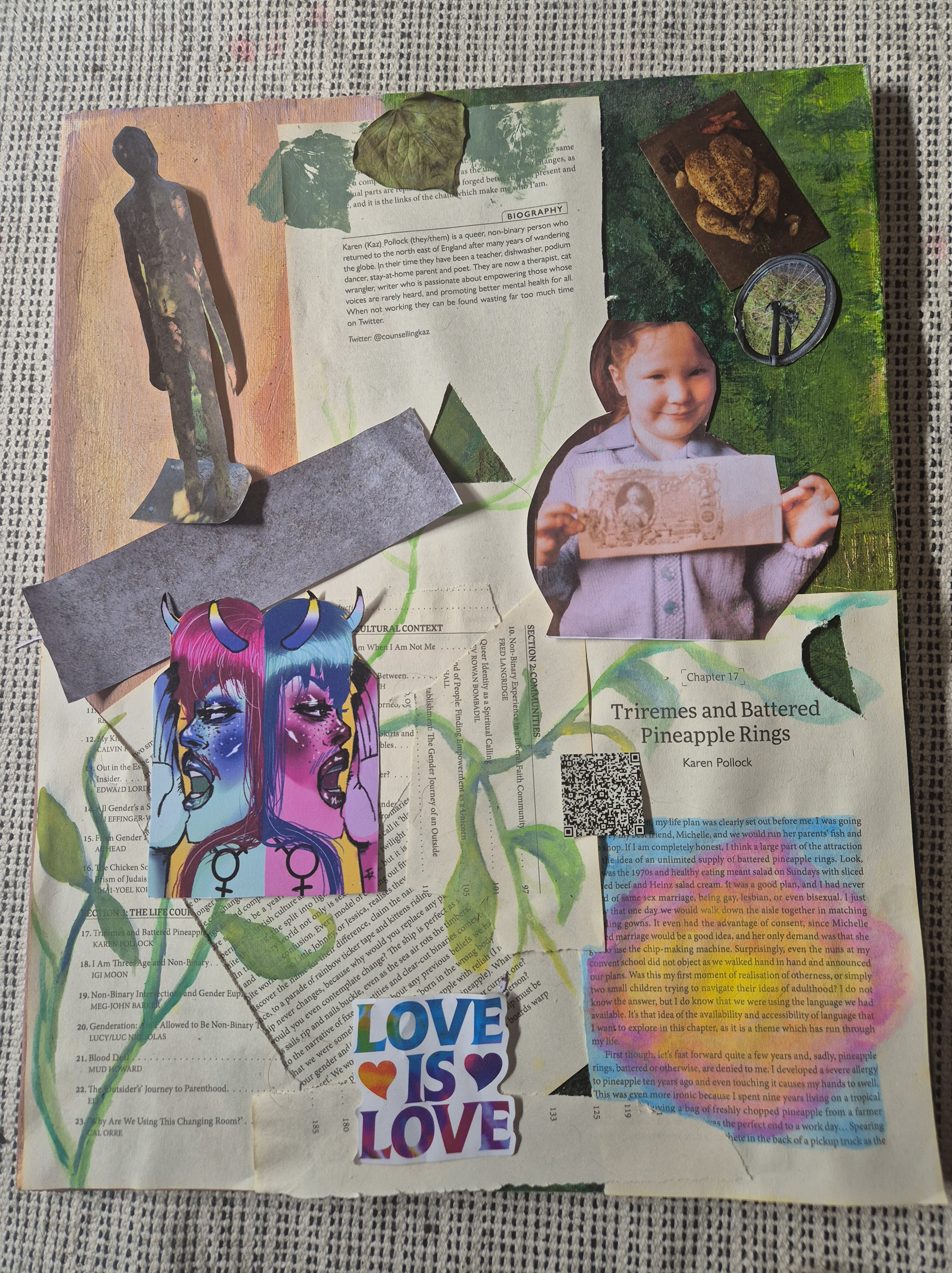
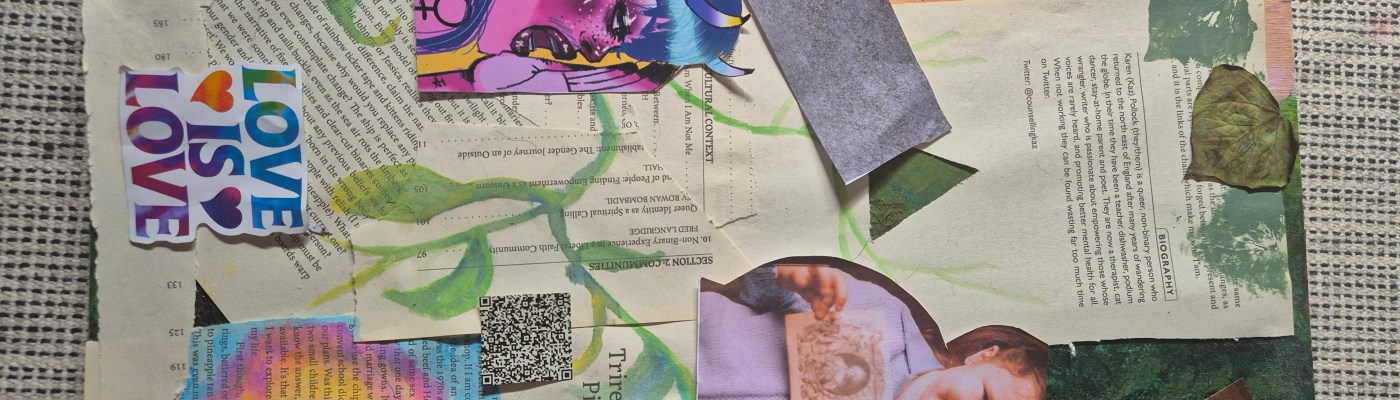
Below is a copy of the creative assignment which we had to complete for the course. To let myself be freed of the shackles of white supremacist academic deadness, was to come alive. The collage for me contains that truth, as therapists and supervisors we must be life bringers, and the zombie pages of academia are rarely places of life. Instead they become graveyards of hopes and dreams, places where theraputic life is buried. I hope you too see how much growth and life there is in this piece, and how much I enjoyed creating it.
I was first drawn to the idea of creating a piece of art, rather than writing because a lot of my process around supervision, and psychotherapy in the past couple of years can be summed up by the idea – therapy is an art not a science. As a person centered therapist, and anti oppressive supervisor and therapist I have spent a lot of time reflecting on the Carl Rogers quote –
People are just as wonderful as sunsets if you let them be. When I look at a sunset, I don’t find myself saying, ‘Soften the orange a little on the right hand corner, and put a bit more purple along the base, and use a little more pink in the cloud color.’ I don’t do that. I don’t try to control a sunset. I watch it with awe as it unfolds” Rogers, C. R. (1995). A way of being. Houghton Mifflin. (Original work published 1980)
Academic prestige is a tool of control within white supremacy, and one that is often given a pass when other more blunt tools might be challenged. It is a way soft power, which is in fact rarely soft, is exercised. Academic language, structures and norms which means white, middle class language, structures and norms, is the weapon of gate keeping and exclusion. One of the ways I attempt to challenge this within my work is by grounding the connection in the things to hand, to everyday, but also by challenging the idea citations are evidence of anything but knowing how to pay to use an APA citation generator.
This may sound cynical, it is not intended to, because, when we free ourselves from the idea there is only one form of knowledge one way to have expertise, one set of wisdom to be respected, we free ourselves to love the sunset, and recognise it is not the sunset that needs to change but it may be the mountains that need to be moved.
As Dr Mullan says in Decolonising Therapy –
This work also highlights the need to return back Home: to our ancestry, to many of our practices, our medicines, our native tongues, and our communal ways of thriving, while reconfiguring and integrating these practices into the present and future.”
― Jennifer Mullan, Decolonizing Therapy: Oppression, Historical Trauma, and Politicizing Your Practice
Psychotherapy, and by extension supervision (a term I actually dislike intensely for its panepticon overtones of surveillance and control) has been an attempt by cis het white middle class men to build walls of exclusion around the practices which other genders, other races, other ways of being had offered and provided for millenia, be it the anchorites who meditated or the elders who held wisdom. Which is not to romantise the past, or fall for the naturalistic fallacy, science has its part, but it is also used as a knife to cut us off from our, metaphorical and real, sense of awe, when we watch a sunset.
The Process of the Collage.
After determining to do a piece of art rather than a traditional academic style essay, a collage leapt into my mind from that unconscious well we call inspiration. It seemed very fitting as a creative way to engage with the assignment.
In the practice of supervision, we reject the myth of the blank slate. No one enters the room as an empty canvas. We are vivid, complex tapestries of our lived experiences, prejudices, and ancestral knowledge that is within us, and between us. To represent this work, a collage seems far more fitting than a clinical chart. Thinking of Sanders and and Wilkins, and their integrative model of supervision a collage can reflect their presentation of a systems perspective, where there are multiple, overlapping relationships within and outwith the supervisory relationship. They described the ideal as a supervisory relationship which is co-created, and overlapping, built from separate parts, just as the collage is. When we meet, we are not just discussing a case, but weaving together three distinct and intersectional lives, which we name as supervisor, supervisee and client. . Each part represents a different fragment of our identities—our histories, our biases, and the systemic forces that shape us and shape the supervisory relationship.
This medium has long been a tool for resistance. Whether the work of Romare Bearden, a Black artist who used collage to fracture and reassemble the Black experience, or Hannah Höch, a queer pioneer of the Dada movement who used the medium to dismantle cis-heteronormative beauty standards and gender roles collage was used to challenge the status quo. A collage creates space to actively integrate the diverse cultural narratives in an embodied way.
Constructing the Collage.
Having decided how fitting it would be I then had to consider the actual collage itself. I knew I wanted to use an old canvas, this represents my roots, my whiteness, the canvas of racism/ white supremacy and norms around gender, class, religion, as a Roman Catholic in a country which historically has oppressed catholics, all the the background and cultural heritage in being a white, working class, assigned female at birth person from one of the poorest bits of England. The canvas is growing up without a bathroom, or an inside toilet, and being the first person in my family to go to university, and the canvas is also being able to remember the first time I saw a none white person, visiting London as a child.
Pasted on the canvas are pages from the first chapter I had published – Trimarines and Pineapple Rings Twist, J., Vincent, B., Barker, M.-J., & Gupta, K. (Eds.). (2020). Non-binary lives: An anthology of intersecting identities.I have two copies of this book for the simple reason no one told me that when you are published you get sent a free copy.
It represents all the things we do not know, and how that cuts across the privilege (of knowing) and oppression of excluded knowledge. It also holds the meaning of books as the route out, for the autistic me, the working class me, the queer me, books were the escape route, and how I covered much of the canvas, learning new ideas, thoughts and ways of seeing the world. But the canvas shows through, because it is important we do not, I do not, pretend we can erase the internalised racism, ableism, queerphobia, classism and other prejudices we all imbibe from birth.
The watercolour images on top reflect a number of things, the sunset in the bottom right may seem obvious, but it also a reference to the works of JRR Tolkien, who painted and drew on a number of newspapers due to paper shortages in WW2. The spreading green leaves indicate growth, change, with space at the top for new growth, and by painting on top of the published book I am showing how I believe we must be willing to modify our ideas, to make space for new ones.
The top right corner, dominated by a photo of me as a small child, holding a banknote, reflects those intersections of identity we might call home – parenting, cooking, home-making in a literal sense by earning income, poverty, my bicycle, and making space for the small frightened autistic abused child I carry within me. She can dominate if I do not hold her presence in awareness, but it is important to remember she smiled in her home made cardigan.
The top right corner reflects the traditional view of the therapist, but with the watercolours changing, adapting, and as it is from a photo taken on a PInk Therapy leadership team retreat, also the reality of the power I hold as a supervisor, in tension with my own self concept.
The bottom left represents my queer self, divided, non binary, loud, beautiful, moving over the years from the liberal ease of “love is love” to the anger and revolutionary belief that none of us are free until all of us are free.
I name the corners, but it is a whole, connected, overlapping, a myriad of meanings, all contained within one, which will be interpreted differently by whoever sees it, and where the meaning will change depending on the viewers own experience which lies at the heart of both supervision and therapy.